ROLE ANALYSIS
Adam Blatner, M.D.
First posted August 3, 2005, re-posted 10/05/2011
(An earlier version of this article was
published in 1985, in the 1st and 2nd spiral-bound editions of my
personally published
(at that time) general text,
Foundations of
Psychodrama.
However, it wasn't included in the later 3rd or 4th editions
published
in 1988 and then 2000 by Springer Publishing Company. Here I offer
it
again as a supplement to the chapters on role theory in
Foundations.)
(Revised slightly and re-posted, August 2, 2002) The
other
part of
this earlier chapter, "Looking at Relationships," is also
published
elsewhere on this website as
Our Social
Being-ness.)
In another paper, "
Our Social
Being-ness," I wrote about how human beings are embedded in
networks of relationships at many levels. Within many of these
relationships, there are not just one, but several interacting
roles. A
husband may share the roles of sexual lover and
co-home-maintenance,
co-parent and co-financial support, and many other roles. Thus,
many
roles are complex, especially those which involve our major
relationships and jobs. And when even minor ones become
problematic,
it's usually because there are some conflicts regarding different
role
components. Part of creative problem-solving, then, involves
naming
these sub-roles and role components, and, if necessary, continuing
the
analysis to focus on the sub-components of the components, how
they are
defined, what are the implicit expectations, etc.
The term for breaking down something into its parts
is "analysis," and it doesn't have to mean psychoanalysis. Roles
can be
analyzed too, and because the role concept is so easily
understood, it
makes for a far handier and more practical approach to psychology.
Analyzing a Complex Role Relationship: A Marital Problem as an
Example
John and Jane have been married twenty-five years,
and they are now in middle age. They've been feeling some tension
between them, but they haven't been clear what the issues are.
Instead
of allowing themselves to degenerate into bickering about things
that
they would ordinarily overlook, or to avoid the problem in a
variety of
non-constructive ways ranging from escape into addiction to
psychosomatic illness, they choose to face the situation head on.
They
sit down together and with paper and pen, diagram their
relationship,
listing the roles, something like this: Fig. 1:
Then they review
which roles seem to be going well
and which roles seem to have become problematical. Those which
deserve
further attention are then analyzed by breaking them down into
their
components. For instance, the role of sharing household tasks
contains
such implicit or explicit themes as: who decides who does what;
how is
it decided; what is the actual division of duties; what are the
standards for the performance of each task; and so forth. The
issues
are complex and reflect a number of personal variables such as
interests, temperament, and cultural background. Each situation
must be
diagramed to reflect that unique relationship. One of the reasons
this
approach works is that it helps the participants get away from
their
tendency to talk or argue in generalities and instead focus on
concrete
examples.
In the marriage we are describing, for example, let
us suppose that the most relevant recent issue for John and Jane
has
been in the area of money matters. If that role component could be
magnified, almost as if we were using a "role microscope," the
aspect
of money matters is also affected by a number of variables. Each
of
these could be named and discussed.
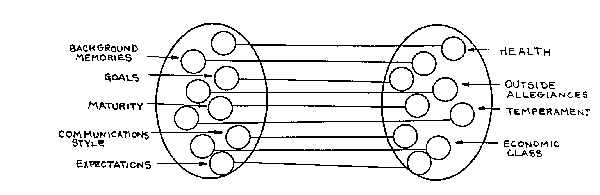
|
Yet even this may not suffice to give a clear enough
picture of what is going wrong, and whichever role component seems
to
be a point of friction needs to be broken down even further, so
those
elements can be defined clearly. Thus, in analyzing the issues
regarding money matters in this hypothetical marriage, let us say
Jane
is uncomfortable with the way John spends money. Analysis of the
components reveals that she comes from a background of being quite
poor
as a child; but their present economic class is shifting from a
lower-middle income into a significantly higher tax bracket; and
John's
temperament is such that he spends more freely than his wife is
comfortable with. In addition they have some special difficulties
regarding their style of communications. These issues could be
diagramed further to reveal the various sub-components of these
roles
(Left, Fig.2):
And in turn, each of these sub-components have sub-sub-components,
or
variables or factors that affect how these sub-components are
expressed Even these elements can be analyzed further.
In the
example of this marriage, a discussion of the sub-component
relating to
their communication patterns reveals that Jane is relatively
nonassertive, because she lacks confidence (partly based on the
fact
that she never graduated high school); also she has accepted the
cultural cliche of being somewhat unquestioning about finances as
her
definition of the role of a proper wife; the fact that John is
also
several years Jane's senior tends to reinforce her tendency to
passively defer to him. Still, she is uncomfortable about how much
money is being spent and it's beginning to come out in indirect
ways;
and she's not altogether conscious of this as a distinct issue.

|
Another problem in the marriage is that John has had
some symptoms which suggest that he might need a medical check-up
, and
in fact he's expressed his concern about his health. When Jane
picks up
on this, though, John then denies there's a problem and instead of
giving his wife the detailed reassurances she needs, he teases and
offers glib responses. Her response is to feel he's making fun of
her
and she begins angrily nagging him. Again, they aren't clear about
these issues and John has not understood why Jane has become so
touchy (Right, Fig 3:):
The Dance of Relationships
Of course, all these role relationship categories and other variables
are in constant flux, as is very roughly diagramed in the picture
(Figure 4, Left). Part of the art of living creatively is to appreciate
some of these variables, perhaps learn how to comment on them with the
other person in the relationship, work out new, more effective
arrangements. All this is only possible if you know the types of
variables involved. There is immense variablility in which categories
are more relevant in which sub-role relationship. Some may be worked
out well, others still unresolved. For most people, these subtleties
remain unconscious. Identifying them, naming them, allows you to begin
to work with them more consciously.
Summary
Each component and sub-component of the
roles in most relationships can be methodically analyzed, and this
approach introduces a structure and obvious rationale to the often
seemingly ambiguous process of trying to figure out what causing a
sense of friction. It has the advantage of demystifying the
process.
Role analysis also can be used for diagnosing problems at work or
in
organizations; for clarifying issues in families, such as the
re-distribution of roles when one of the people go to work or
retire;
or in classrooms, to understand the dynamics of relationships in
social
studies, anthropology, or family studies.
It should also be noted that these diagrams change
with the general situation, such as when a marriage shifts from
everyday styles of living together to having the husband's
employer and
his wife over to dinner. Illness or some other major event can
also
lead to significant changes in the way roles are performed, and
it's
helpful to make these conscious and explicit, so that
re-negotiations
can help prevent the build-up of feelings of resentment or
confusion.
References
Blatner, A. (1985). Looking at relationships (Chapter 11), in
Foundations of Psychodrama
(2nd
ed.). San Marcos, TX: Author.
Blatner, A. (2000).
Foundations of Psychodrama: History,
Theory & Practice (4th ed.). New York: Springer.
Hale, Ann E. (1975). The role diagram expanded.
Group Psychotherapy and
Psychodrama, 28, 77-104.
Hale, A.E. (1981).
Conducting
Clinical Sociometric Explorations: A
Manual for Psychodramatists and Sociometrists. Roanoke,
VA:
Author.